MYP 1 Colour and Movement Task 3 - Creating

Criterion C · Create an artwork
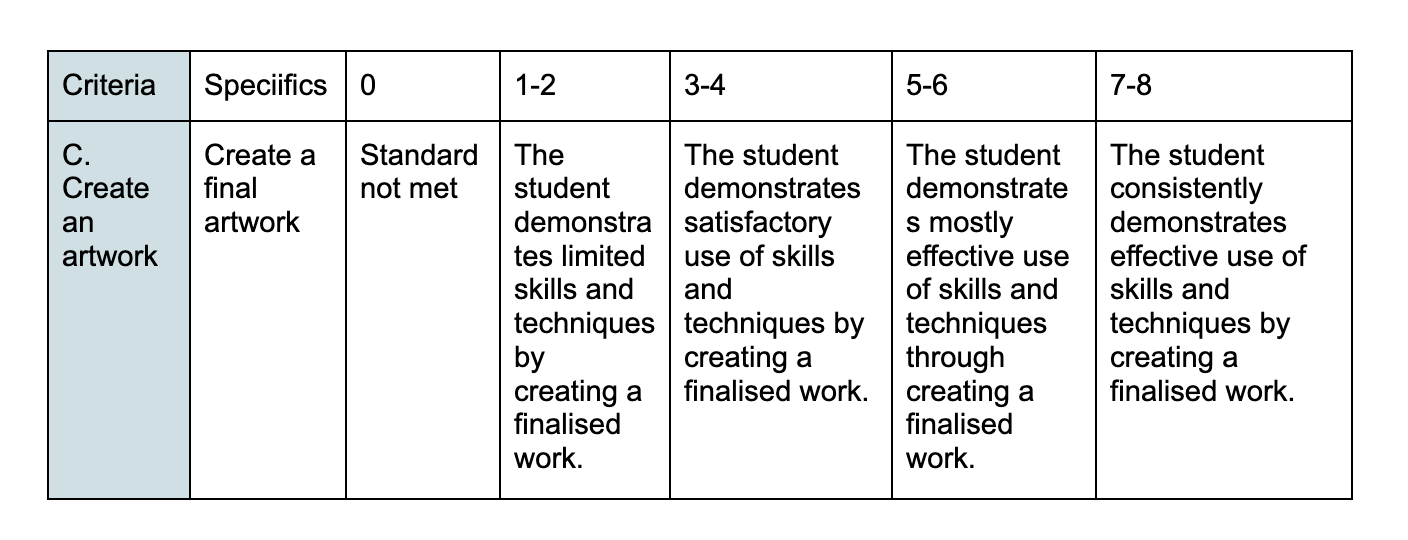
Colour & Movement
Understanding colour and movement helps us understand artistic expression.
About this task
This task focuses on Criterion C: Creating and asks students to develop a final artwork in response to the unit's Statement of Inquiry.
In a full MYP Visual Arts unit, students may work through all four criteria. In other contexts, teachers may design shorter or standalone tasks that focus on a single criterion.
This resource is designed as a standalone Criterion C task. The assessment focuses on the student's ability to create a finalised artwork using the skills and techniques they have developed.
If this task sits within a larger unit, the investigation and experimentation developed through Criteria A and B can provide the foundation for the final artwork.
A note on the creative process
In my experience teaching both MYP and DP Visual Arts, I find value in maintaining a clear creative cycle from investigation and experimentation through to making, reflection and justification.
Students don't necessarily need to follow exactly the same process or arrive at the same outcome. What matters is that they can develop ideas, experiment with skills and techniques, make decisions and apply what they have learned to their final work.
Looking at Criterion C
Create an artwork
For this task, students are assessed on their ability to create a finalised artwork using appropriate skills and techniques.
The 7–8 descriptor asks students to:
demonstrate consistently effective use of skills and techniques through the creation or performance of a finalised work.
The phrase “consistently effective” is important.
The final artwork is not simply an opportunity to make something attractive or technically accomplished. It should demonstrate how students have developed and applied skills through the creative process.
The process journal can therefore be an important part of the journey towards the final work. It can show experiments, decisions and developments that have informed the final artwork.
The final artwork becomes a culmination of this development rather than an isolated product.
Student Task
Create an artwork
Create a final artwork connected to the Statement of Inquiry:
Understanding colour and movement helps us understand artistic expression.
Your artwork should:
- respond to the Statement of Inquiry;
- demonstrate ideas you have developed during the unit;
- show the skills and techniques you have experimented with;
- make purposeful use of materials and processes;
- communicate your own artistic ideas.
Use your Visual Arts journal to support your development.
Look back at your experiments and ideas and consider:
- What have you discovered about colour?
- What have you discovered about movement?
- Which techniques or materials have been most successful for your ideas?
- What decisions have you made as your artwork developed?
- How does your final artwork connect to the Statement of Inquiry?
Share your work
When your artwork is complete, present it to a peer.
Talk briefly about:
- your idea;
- how it connects to the Statement of Inquiry;
- the skills and techniques you used;
- an experiment or decision that influenced the final work.
Your peer can ask you questions about your artwork and creative process.
Teacher note: The presentation is an opportunity for students to communicate their thinking. For this task, the assessment focus remains Criterion C: Creating.
Teacher Assessment
Criterion C · Creating
Use the MYP Criterion C rubric to assess the final artwork.
When assessing, consider how effectively the student has:
- applied relevant skills and techniques;
- used materials and processes;
- developed and realised their artistic ideas;
- created a finalised work.
Evidence for assessment
The primary evidence for Criterion C is the final artwork.
The Visual Arts journal can provide useful supporting evidence of skill development and decision-making, but it should not replace the final artwork as the focus of the criterion.
Extension / Full Unit
This task can also form the Creating stage of a larger MYP Visual Arts unit.
In a full unit that is designed chronologically:
Criterion A — Investigating
Students explore artists, contexts, ideas and visual research.
↓
Criterion B — Developing
Students experiment with skills and techniques and develop ideas through their process journal.
↓
Criterion C — Creating
Students apply their learning to create a finalised artwork.
↓
Criterion D — Evaluating
Students reflect on and evaluate their artwork and creative process.
The four criteria can work together to create a coherent creative cycle, while individual tasks can also be designed to focus on a particular criterion.
Example
Rubric for this Task