THE UNEXPECTED

The important part is not the technique. It is the looking.
ISSUE 01 · SEPTEMBER 2026
It's the beginning of a new school year, and I've been thinking about the artists I want to have in my classroom this year.
New students. New classrooms. New sketchbooks. New units to plan. New ideas that seemed brilliant in June and suddenly feel rather less brilliant when you actually have thirty students sitting in front of you.
But the start of a school year is also a good moment to look for something unexpected. An artist you've never taught before. An idea you haven't tried. A material that behaves differently from how you thought it would.
This month, that artist is Cornelia Parker.
THE ARTIST I WISH I'D DISCOVERED EARLIER
Cornelia Parker
There are artists whose work you admire. And then there are artists who change the way you look at things. Cornelia Parker is one of those artists for me.
She takes things we think we understand and makes them strange again. Silver objects are flattened. Everyday materials are suspended. Objects are crushed, exploded, stretched, cut apart and reassembled.
But the transformation isn't really the point. What interests me is what happens after it. A familiar object suddenly carries a different story. Something destroyed can become beautiful. Something beautiful can become unsettling. Suddenly, we're looking at the object rather than simply recognising it.
That is what I find so useful about Parker's work in an art classroom. She gives students permission to stop asking “How do I make this look good?” and start asking “What could happen if I changed it?”
Cornelia Parker
Cold Dark Matter: An Exploded View, 1991
View the artwork →Artwork
Parker's work starts with things students already know — a spoon, a coin, a toy, a piece of clothing, something broken, something completely unremarkable. Then she changes the object's physical state, and in doing so, changes the way we think about it. For younger students, that's a simple, wonderful introduction to material and process. For older students, it opens up much bigger questions about memory, identity, value and meaning.
TRY THIS IN THE MYP ART ROOM

YAB STUDIO SPARK
CHANGE
Change the Object
Ask students to bring — or choose — an ordinary object. Nothing precious. Nothing they are afraid to change.
A piece of paper. A bottle cap. A cardboard box. A spoon. A pencil. A piece of packaging. An old toy.
Their challenge is simple: transform it.
They might cut it, fold it, flatten it, combine it with something else, repeat it, enlarge it, shrink it, turn it inside out, deconstruct it, or photograph it differently.
The important part is not the technique. It is the looking.
Ask them to photograph the transformation or write about it in their journals.
How did you change the object?
FOR ALL OF US THAT CONTEMPLATE THE STUDIO
ONE QUESTION TO TAKE AWAY
At what point did it stop being what it was?
Ask it of the object your students transformed. Then ask it of your own practice — the units you're revisiting, the habits you've carried over from last year, the ideas that felt fixed. At what point does something stop being what it was, and start being something else entirely?
STUDIO NOTES
When the unexpected becomes part of the work
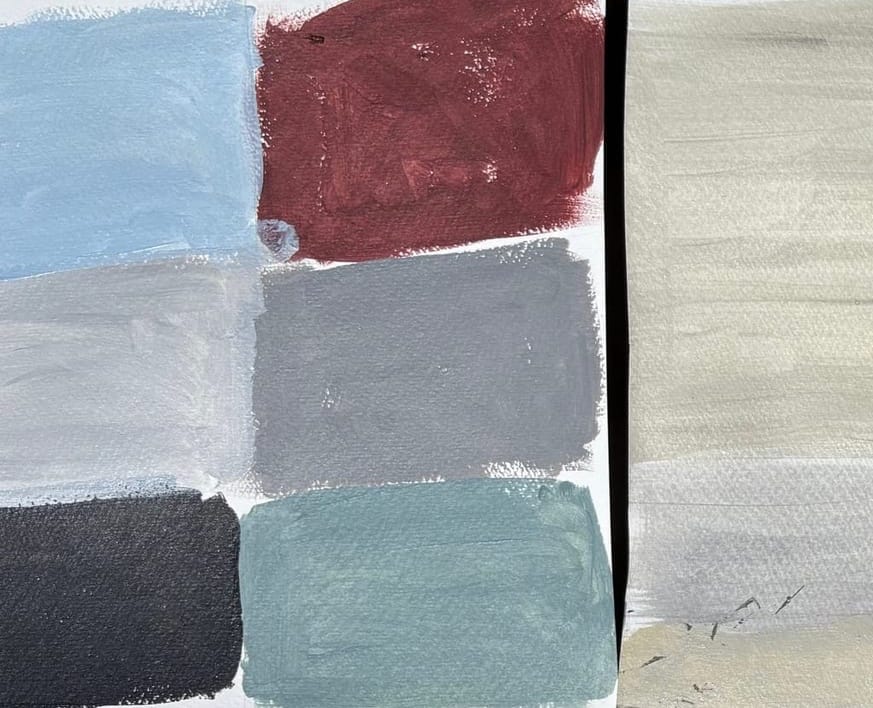
DECONSTRUCT THE COLOURS FROM A PHOTO.
Example: Image Prompt - What colours do you see? Can you create the same colours?

When the unexpected becomes part of the work
One of the things I continually come back to in my own studio practice is the uncomfortable space between intention and accident.
You begin with an idea. You make a mark. Something doesn't work. You paint over it. Then something underneath starts to appear.
You hadn't planned it. But suddenly it is more interesting than the thing you originally intended to make. It makes me wonder what happens when we give students permission to do the same. A colour isn't quite right. A mark behaves differently. An experiment produces something unexpected. There is a moment when we can either correct it and return to the plan — or pause, look again and ask:
What happened here? And what could happen next?
I think this is one of the reasons I find artists like Cornelia Parker so compelling. They remind us that making art isn't always about executing an idea perfectly. Sometimes the material has something to say too.
The unexpected becomes part of the inquiry. The process. The work changes, and the student's thinking changes with it.
Perhaps this is one of the quiet strengths of making: sometimes the work doesn't just answer our questions — it changes them.
THE YELLOW ART BOOK
I spent years writing MYP Visual Arts curriculum resources before deciding to build something entirely my own. The Yellow Art Book is that — over 500 pages of artists, ideas and practical resources for MYP Art, covering Years 1–5.
The library is growing all the time, and I'd love you to join me for the year.
Subscription available from 30/09/2026
Until next month,
Keep looking. Keep making. Keep finding the unexpected.
Emma
THE YELLOW ART BOOK · theyellowartbook.com